


AIR COMPRESSOR BUYERS GUIDE
Your guide to choosing the perfect pneumatic powerhouse for your workshop
Ready for a workshop upgrade that’s sure to blow you away? From filling tyres and clearing dust to powering rollercoasters and helping astronauts touch down (no really, it’s a thing), air compressors are truly versatile bits of kit. Paired with the right air tools, you can use a compressor to match the job of almost any electric power tool, power a spray painting setup or sandblasting cabinet, fill tyres, air-clean, and so much more. At SGS we have a vast array of compressors to meet any need, and are here to help you pick the right one for your use case.
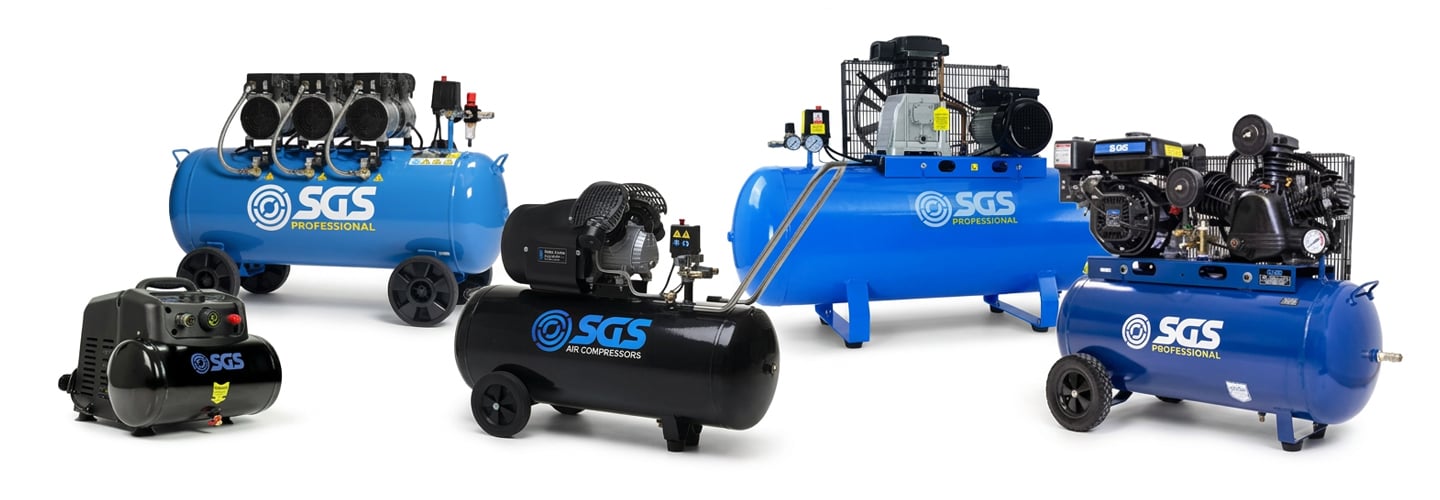
Background
Before we get into specs, a brief rundown of how a compressor actually works:
- The unit typically has two parts, a tank to hold compressed air, and the actual compressor.
- The compressor sucks in air from the air around it, and uses one of two methods to compress it;
- Reciprocating, the most common type of consumer compressor, drives a piston with a crankshaft that packs the air into the tank in a series of back and forth motions
- Screw, a more specialist solution, spins a pair of interlocking helical screws in opposite directions, effectively making the space for the air smaller and smaller from one end to the other, providing a constant stream of compressed air
- The tank stores as much compressed air as it can until it hits its rated pressure, then automatically cuts out.
- When a tool connected to the tank requires air, a trigger on the tool opens a valve which allows the air to escape from the tank, a bit like opening the neck of a balloon, and the air rushes through the tool to power it.
Even Flow, Under Pressure.
Funnily enough, when looking into air compressors, the top 2 most important specs are the air flow and air pressure that it can provide. Each air tool has a pressure (usually measured in PSI or Bar) and an air flow (usually rated in CFM) that it requires for operation.
An important distinction to make is that the air flow rating of a compressor being over a tool’s requirement is not an issue, whereas the pressure being too high can be; a too high pressure will wear out a tool much faster, and too low will make it lack power. To avoid this, you should use a pressure regulator. All SGS brand Air Compressors have a regulator built in, so this isn’t an issue with ours. Most SGS Air Compressors are also rated to 115 PSI maximum, enough to run pretty much any air tool.
Back to airflow, if you have enough coming from the compressor, you can actually run multiple tools provided the total CFM of the compressor is greater than the sum of the CFM requirements for each tool. You want to aim to have a little extra headroom on top so that the compressor isn’t running constantly under load, about 10-20% more CFM than is required by your air tools is good.
Maximum Flow
The SC150B is SGS's highest air flow compressor. An enormous 14CFM means the large tank fills quickly and means that while in use, the motor kicks on less often.
The SC100V is our flagship compressor, slightly less capacity than the SC150B, but packing almost the same air flow means it fills up from empty in under 5 minutes.


Capacity Counts.
Generally speaking, the larger your air compressor’s tank is, the longer you can run your tools before the internal tank pressure drops too low. This somewhat depends on the air tools you want to use though and how ‘constant running’ they are.
For example, an air powered nail gun only requires a very short burst of air every shot meaning it can run on quite a small tank with the compressor easily refilling the tank between shots. Conversely, an air sander is activated for longer, sustained stints, meaning you’ll need a larger tank to keep it running without losing pressure for longer, allowing you to keep using the tool for longer. Consumer grade compressors usually range from 6L to 150L of tank capacity, use the table below to determine what size tank you need:
| Tank Size | Suitable Applications | Typical Usage |
|---|---|---|
| 6L – 24L | Tyre inflating, blow-gun clearing, airbrushing, brad stapling | Light garage work, domestic DIY, mobile tasking |
| 50L – 90L | Impact wrenches, ratchet spanners, short spray bursts, tyre changers | General automotive work, home workshops, mechanics |
| 100L+ | Continuous air sanders, full vehicle spray painting, shot blasting | Commercial garages, bodyshops, heavy industrial use |


Driving Force.
When looking under the bonnet, how the motor connects to the pump makes a big difference to longevity, performance, and maintenance:
- Direct Drive: The motor is connected directly to the compressor pump shaft. This means fewer moving parts, a more compact footprint, and a lower price tag—making them the go-to choice for home garages, hobbyists, and mobile mechanics.
- Belt Drive: The motor drives the pump via a belt and pulleys. This allows the pump to run at lower RPMs while still delivering massive CFM output. Belt drives run cooler, last significantly longer under heavy, industrial workloads, and are built for professional workshops where the compressor runs for hours at a time.
So, picking the right drive type essentially comes down to your use case. If you’re using your compressor in the home or for lighter workloads, direct drive is usually the way to go. Any heavier, industrial or commercial applications, consider switching up to a belt drive.

Well Oiled Machine.
Choosing between an oiled and an oil-free air compressor comes down to air purity, maintenance requirements, and how often the machine will be run:
- Oil-Less Compressors: These models use self-lubricating piston rings and synthetic coatings, eliminating the need for oil sumps. Because of this, they need virtually zero lubrication maintenance and deliver oil-free air, making them ideal for clean-air applications like automotive spray painting, airbrushing, and food/medical environments.
- Oiled Compressors: Like in a car engine, the piston walls and bearings in an oiled compressor are immersed in oil to reduce friction and dissipate heat during operation. Oiled compressors generally deliver extended operational lifespans under heavier workloads, though they require routine oil checks & changes to maintain peak performance.
So, much like direct vs belt drive, oiled vs oil-less depends on your use case. Generally speaking:
Buy Oil-Free if: you do spray painting, airbrushing, light home DIY, need quiet operation, or want zero maintenance.
Buy Oiled if: You run heavy air tools (sanders, ratchets, grinders), run your compressor for hours on end, or want a long-term workshop workhorse that lasts decades.


Power Up.
Where are you planning to plug in? Can you plug in at all? Where and how you operate your compressor dictates what power source you’ll need.
- Standard Electric (230V Mains): Standard for almost all home garages and domestic workshops, plugging straight into a standard 13A mains socket (though larger 50L+ units may require a 16A supply or dedicated circuit to handle startup draw). If you have good access to standard mains electrics, go for this.
- Three-Phase Electric (400V): Found strictly in commercial garages and industrial units, delivering high-wattage power for heavy-duty, multi-cylinder compressors. You’ll probably know already if your space can accommodate one of these.
- Petrol or Diesel Powered: For mobile mechanics, site work, or remote locations without grid power, engine-driven compressors offer complete independence from plug sockets.
A quick pro tip is never to run a compressor from an extension lead . Compressors draw high current at startup and extension leads can cause voltage drops, both things which overheat and damage the motor or can trip fuses or surge protections. If you need extra reach, always use a longer air hose rather than a longer electric extension cable.
Combustion Power
The SC901P is SGS's own brand petrol compressor. Giving you the freedom to power your air tools from anywhere, any time.

Volume Control.
Air compressors are notoriously noisy workhorses; screaming pistons and rattling motors can turn a peaceful garage afternoon into a headache. Fortunately, technology has evolved. If you work in a residential area, hate wearing ear defenders indoors, or share a workspace where you actually want to hold a conversation, a super-silent compressor is worth its weight in gold. These units utilise advanced motor designs to drop decibel levels dramatically (often to around / below 60 dB), letting you inflate tyres or run air brushes without startling the entire neighbourhood.


Tools For The Job.
A compressor on its own is only half the battle; it's the air tools at the end of the hose that do the actual graft. Buying items individually can add up quickly, which is why SGS offers comprehensive air compressor tool sets and kits. From starter kits featuring blow guns, tyre inflators, and spiral hoses, to complete spray-painting and impact wrench bundles, grabbing a kit saves you money and ensures instant compatibility right out of the box
Tools, Kits, & Built In Bits
Tool up with our huge range of Hose Reels, Air Tools, Combo Kits and Compressors with integrated extras.


The Final Verdict: Selecting the Right Compressor
Buying an air compressor isn't just about buying a tank of compressed air; it's about matching your workflow to the right machine so you're never left waiting for air to catch up.
The DIYer / Home Enthusiast: Up to a 50L direct-drive unit is your sweet spot. It'll be compact enough for a corner of the garage, powerful enough for car maintenance, tyre inflation, and nailing, and won't break the bank.
The Serious Workshop / Mechanic: Step up to a 100L+ compressor and consider switching to belt-drive. The higher CFM and durability mean you can run air ratchets, sanders, and spray guns all day long without dropping pressure.
The Bodyshop / Spraying Specialist: Look for an oil-free super-silent unit if working at home, or combine an oiled compressor with inline oil and moisture filters to ensure clean, dry air for pristine paint finishes.